Understanding the methods of decentralization in blockchain is key to grasping why this technology has changed how we think about trust, ownership, and data, with no middlemen required.
Blockchain technology continues to reshape industries from finance to healthcare. But at its core, what makes blockchain truly powerful is decentralization.
Instead of relying on a single authority, such as a bank or government, to manage data, blockchain distributes that power across a network of participants.
In this guide, we break down the main methods of decentralization in blockchain so you can understand how the system actually works.
Before you read this article, we suggest taking a look at our previous post: What is Decentralization in Blockchain? It explains the basic idea of decentralization in plain words and gives you a solid starting point.
What Is Decentralization in Blockchain?
Decentralization means no single entity has control over the entire network. Every participant (called a node) holds a copy of the data. Decisions, validations, and transactions happen through consensus, not permission. This is the foundation of blockchain’s trust model.
There are several different methods of decentralization in blockchain, each serving a different purpose depending on the network’s design and goals.
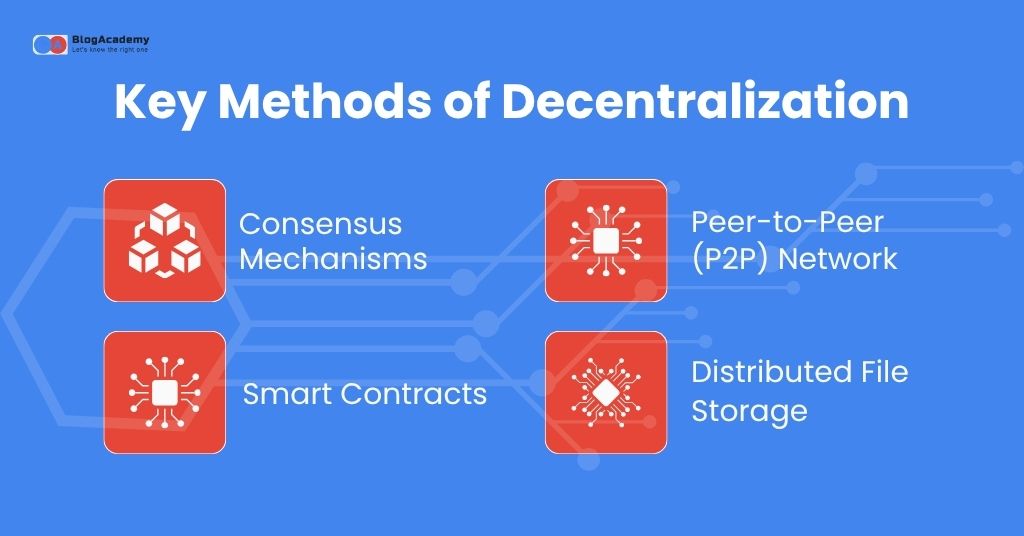
Key Methods of Decentralization in Blockchain
Consensus Mechanisms
The most fundamental method is the consensus mechanism. Bitcoin uses Proof of Work (PoW), where miners compete to solve complex puzzles. Ethereum now uses Proof of Stake (PoS), where validators are chosen based on the amount they lock up as collateral. Both methods prevent any single party from manipulating the ledger without incurring enormous costs or consequences.
Peer-to-Peer (P2P) Network Architecture
Traditional apps rely on central servers. Blockchain networks use a P2P model; every node connects directly with others. This spreads data across thousands of computers worldwide, making the network resilient, censorship-resistant, and nearly impossible to shut down.
Smart Contracts
Smart contracts are self-executing programs stored on the blockchain. They run automatically when conditions are met, no human approval needed. This removes intermediaries from processes such as lending, insurance claims, and supply chain verification, pushing real decision-making power back to the user.
Decentralized Autonomous Organizations (DAOs)
DAOs are community-governed organizations. Token holders vote on proposals from project direction to treasury spending. There’s no CEO making decisions in a boardroom. This is one of the most visible methods of decentralization in blockchain at the governance level, giving real power to the community.
Distributed File Storage
Platforms like IPFS (InterPlanetary File System) store data across many nodes rather than a central server. Even if one node fails, the data remains accessible. This ensures no single company can delete or restrict content stored on the network.
Cryptographic Key Management
In blockchain, your identity is your private key. No username, no password reset, no central database holding your credentials. You control access entirely. This is a critical but often overlooked aspect of how blockchain decentralization puts users in charge of their own digital presence.
Why Does Decentralization Actually Matter?
Decentralization isn’t just a technical design choice; it’s a philosophy. It removes the need to trust institutions and instead relies on transparent, programmable rules. This creates systems that are more resistant to censorship, fraud, and corruption.
Whether you’re a developer, investor, or simply a curious reader, understanding the methods of decentralization in blockchain helps you evaluate which blockchain projects are genuinely trustless and which ones only claim to be.
Frequently Asked Questions
What is the simplest definition of decentralization in blockchain?
Decentralization means no single person, company, or server controls the network. Instead, control is distributed across many participants worldwide.
Which consensus method is most decentralized, PoW or PoS?
Both have trade-offs. PoW distributes mining widely but favors those with expensive hardware. PoS is greener but can concentrate power among large token holders.
Can a blockchain be only partially decentralized?
Yes. Many blockchains are “semi-decentralized,” they use distributed ledgers but rely on a limited set of validators or a company-controlled upgrade process.
Are DAOs truly decentralized in practice?
Not always. Voting power in DAOs often concentrates among early investors who hold the most tokens, which can replicate traditional power structures.
How do smart contracts support decentralization?
Smart contracts remove the need for trusted intermediaries; the code executes automatically and transparently, enforcing agreements without human involvement.
Ready to Go Deeper?
Explore more beginner-friendly blockchain guides, Web3 tutorials, and crypto explained, all written in plain language on Blog Academy.