Machine Learning is no longer an innovative concept; it powers recommendation systems, chatbots, fraud detection, healthcare tools, and even self-driving cars.
As businesses increasingly rely on AI-driven decision-making, the demand for Machine Learning Engineers is higher than ever in 2026.
If you’ve been thinking about making a career shift or leveling up your tech skills, there’s no better time to become a Machine Learning Engineer than right now.
If you want to build intelligent systems and pursue one of the most exciting tech careers, this guide will walk you through the exact steps in simple, practical terms.
Want to understand the basics first? Read our article on How Does Machine Learning Work? It breaks down the technology in a way that’s easy to follow, no technical background needed.
What Does a Machine Learning Engineer Actually Do?
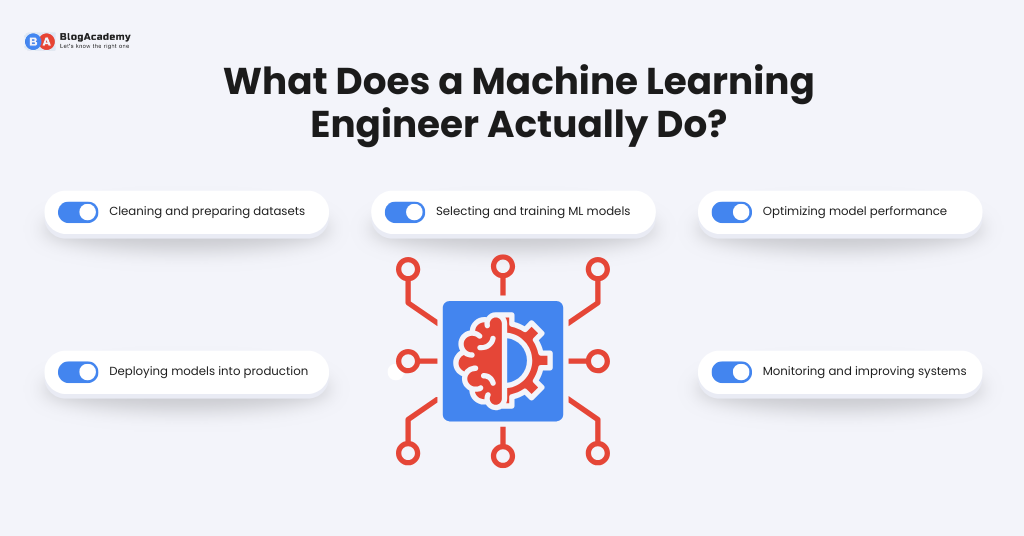
A Machine Learning Engineer designs, builds, and deploys models that allow systems to learn from data. Unlike a traditional software developer, they work closely with data, algorithms, and predictive models.
Some common responsibilities include:
- Cleaning and preparing datasets
- Selecting and training ML models
- Optimizing model performance
- Deploying models into production
- Monitoring and improving systems
Companies like Google, Microsoft, Amazon, and OpenAI actively hire Machine Learning Engineers to build intelligent solutions.
Step-by-Step Roadmap to Becoming a Machine Learning Engineer
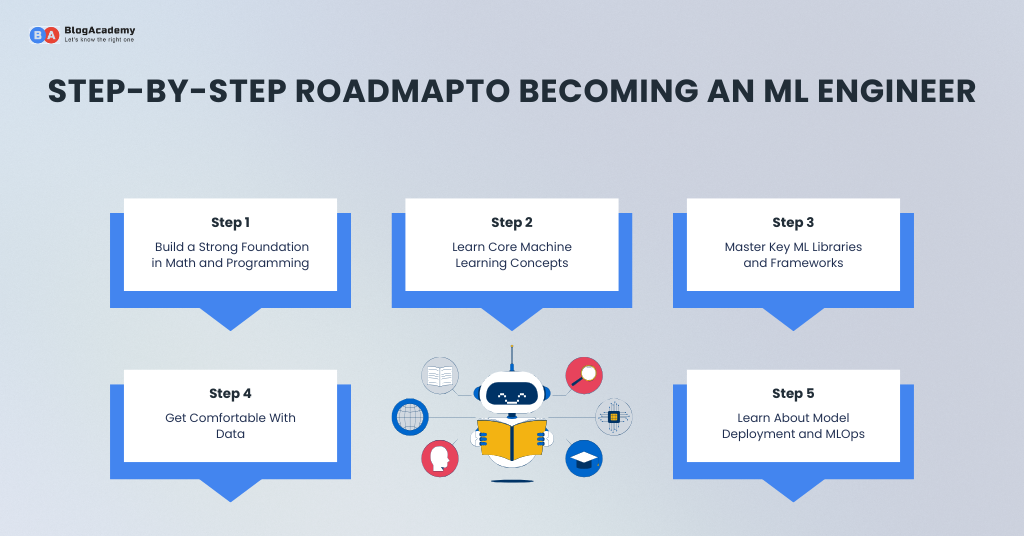
Step 1: Build a Strong Foundation in Math and Programming
You don’t need a PhD, but you do need comfort with the basics. Focus on:
- Mathematics: Linear algebra, calculus, and statistics are your best friends. These concepts sit behind every model you’ll ever train.
- Python: It’s the language of machine learning. Start with core Python, then explore libraries like NumPy, Pandas, and Matplotlib.
Spend 2–3 months on this phase. Free resources like Khan Academy, fast.ai, and freeCodeCamp are great starting points.
Step 2: Learn Core Machine Learning Concepts
Once you have a programming base, it’s time to dig into the actual theory. Study supervised and unsupervised learning, model evaluation, overfitting, regularization, and feature engineering.
Andrew Ng’s Machine Learning Specialization on Coursera remains one of the most recommended starting courses in 2026. It’s structured, beginner-friendly, and comprehensive.
Step 3: Master Key ML Libraries and Frameworks
To truly become a Machine Learning Engineer, you need hands-on experience with the tools used in the industry:
- Scikit-learn: For traditional ML algorithms
- TensorFlow / PyTorch: For deep learning
- Hugging Face Transformers: For working with language models
- MLflow or Weights & Biases: For experiment tracking
Build mini-projects as you learn. A GitHub portfolio filled with real ML projects is worth more than any certificate alone.
Step 4: Get Comfortable With Data
Machine learning runs on data. You need to know how to clean messy datasets, handle missing values, engineer features, and understand what your data is really telling you.
Practice on real datasets using platforms like Kaggle. Competing in Kaggle challenges also helps you build problem-solving instincts that you simply can’t get from tutorials.
Step 5: Learn About Model Deployment and MLOps
Here’s where many learners stop, and it’s exactly where you shouldn’t. Knowing how to train a model is one thing; knowing how to deploy it into production is another.
In 2026, employers expect ML engineers to understand:
- REST APIs and model serving (FastAPI, Flask)
- Docker and containerization
- Cloud platforms like AWS SageMaker, Google Vertex AI, or Azure ML
- Basic CI/CD pipelines for ML workflows
This is the MLOps side of the role, and it makes you significantly more employable.
What Skills Are Employers Looking for in 2026?

The job market has shifted. Employers today want ML engineers who can also work with generative AI tools, prompt engineering, and fine-tuning LLMs.
If you can combine classical machine learning knowledge with modern AI capabilities, you’ll stand out in any hiring process.
Soft skills also matter; communication, collaboration, and the ability to explain complex models to non-technical stakeholders are consistently ranked highly by hiring managers.
How Long Does It Take?
With consistent effort (10–15 hours per week), most people can become a Machine Learning Engineer within 12 to 18 months. A focused, full-time learner can do it in 6 to 9 months. The key is consistency. Learn. Build. Share. Repeat.
Do You Need a Degree to Become a Machine Learning Engineer?
A Computer Science degree helps, but it is not mandatory in 2026.
Many successful engineers learned through:
- Online courses
- Bootcamps
- Self-study
- Open-source contributions
Skills and portfolio matter more than a traditional degree.
Career Path After Becoming an ML Engineer
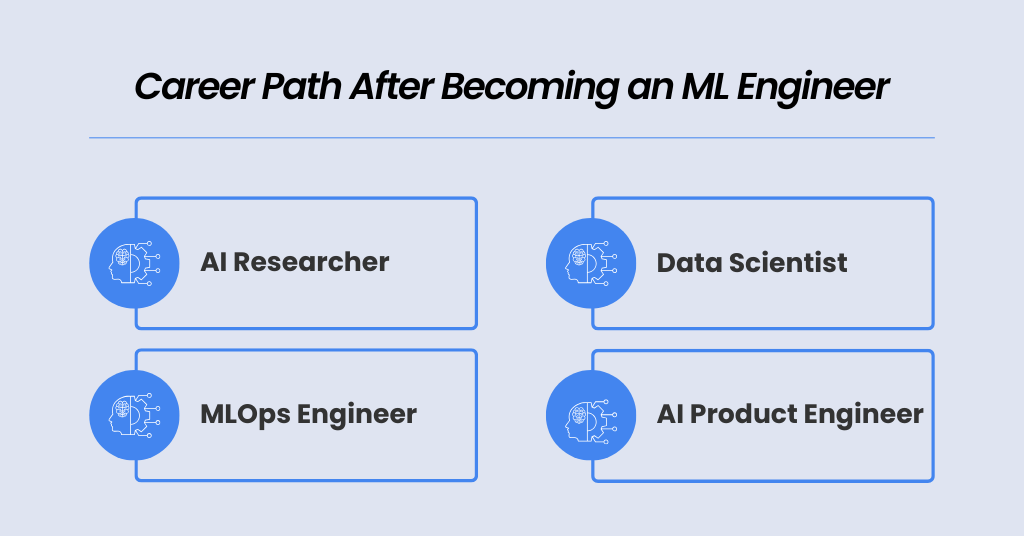
After gaining experience, you can move into:
- AI Researcher
- Data Scientist
- MLOps Engineer
- AI Product Engineer
The field continues to evolve, creating new opportunities every year.
FAQ: Becoming a Machine Learning Engineer in 2026
Q1: Do I need a computer science degree to become a Machine Learning Engineer?
No. Many successful ML engineers are self-taught or come from adjacent fields like mathematics, physics, or even economics. A strong portfolio and demonstrable skills matter more than a degree.
Q2: Is Python the only language I need?
Python is essential, but knowing SQL for data querying and a bit of Bash scripting for working in Linux environments is also useful.
Q3: How much do Machine Learning Engineers earn in 2026?
Salaries vary by country and experience, but ML engineers remain among the highest-paid professionals in tech, with mid-level roles in the US averaging between $130,000–$180,000 annually.
Q4: What’s the difference between a Data Scientist and a Machine Learning Engineer?
Data Scientists focus more on analysis and insights. ML Engineers focus more on building, scaling, and deploying models in production systems.
Q5: Are there free resources to learn machine learning?
Absolutely. Fast.ai, Google’s ML Crash Course, Kaggle Learn, and YouTube channels like Sentdex or 3Blue1Brown offer excellent free content.
Ready to Start Your Journey?
The path to becoming a Machine Learning Engineer is clear; it just takes commitment and the right resources. Whether you’re a complete beginner or a developer looking to specialize, 2026 is the perfect year to leap.
Explore more career guides, tutorials, and learning resources at BlogAcademy.tech is your go-to hub for tech education that actually makes sense.
Start learning today. Your future self will thank you.